
Thriving Kids and Levels of Function

Start learning about Thriving Kids and the Levels of Function (Low, Moderate and High)
Thriving Kids Image_chatGPT_190526

What is the NDIS “severity score” and why does it matter for Thriving Kids?

As NSW prepares for the new Thriving Kids program, one of the biggest unanswered questions is how children will be assessed as having “low to moderate support needs.”

The NSW Government says Thriving Kids will start from October 2026 and will provide services for children aged 8 and under with developmental delay and/or autism who have low to moderate support needs, along with their families, carers and kin.

That sounds positive, but families and providers need clarity about how “low to moderate support needs” will actually be decided.

The NDIS already uses language around level of function and severity score.

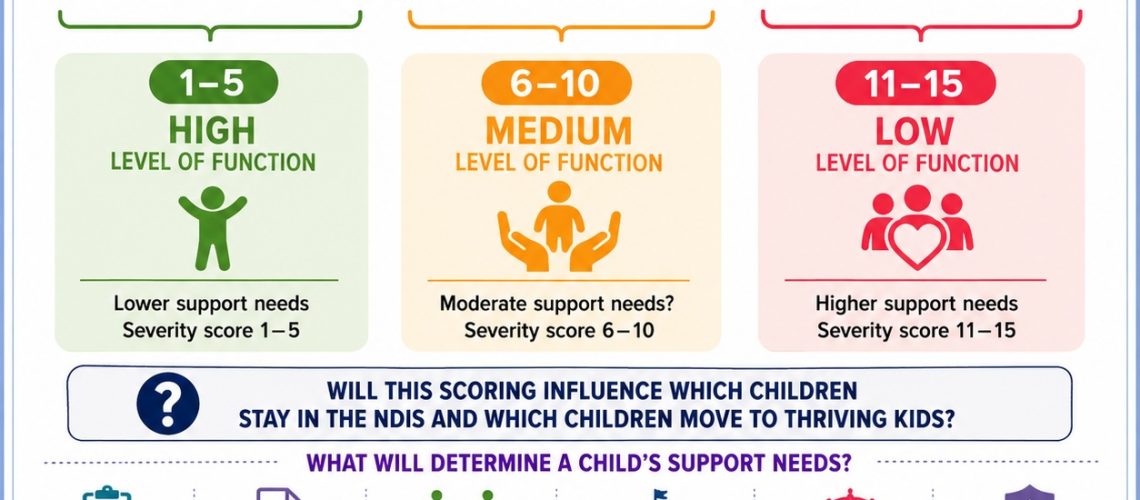
From publicly available information, we know that NDIS participants can be grouped by reported level of function, with severity scores generally understood as:

High level of function: lower service and support requirements, severity score 1–5
Medium level of function: medium service and support requirements, severity score 6–10
Low level of function: higher service and support requirements, severity score 11–15

This matters because a diagnosis alone does not tell us how much support a child needs in daily life. A child may have autism or developmental delay, but their functional needs may look very different across home, childcare, preschool, therapy and community settings.

The NDIS autism data to 31 December 2025 shows that active NDIS participants with autism were reported as:

High level of function: 76,562 participants, or 24%
Medium level of function: 186,829 participants, or 58%
Low level of function: 51,749 participants, or 16%
Missing: 9,066 participants, or 3%

For all active NDIS participants, the same data reports:

High level of function: 239,065 participants, or 31%
Medium level of function: 337,953 participants, or 44%
Low level of function: 160,828 participants, or 21%
Missing: 23,596 participants, or 3%

The total number of active participants in that dataset was 761,442, including 324,206 participants with autism.

This is important because the largest group of autistic participants in the NDIS is recorded as having a medium level of function, not low. If Thriving Kids is going to apply to children with “low to moderate support needs”, families need to know whether this will align with existing NDIS severity scores, a new assessment process, or something else entirely.

The broader NDIS data also shows how many children and families could be affected by changes to early childhood support pathways. As at 31 March 2026, there were 774,456 active NDIS participant plans across Australia.

There were also 167,787 active participants aged 0 to 8 nationally.

Autism and developmental delay are two of the largest disability groups in the Scheme. As at 31 March 2026, there were 338,099 active participants with autism as their primary disability nationally. There were also 67,382 active participants with developmental delay as their primary disability nationally.

This is why the definition of “low to moderate support needs” matters.

Even if only some children are affected by the Thriving Kids changes, the numbers are significant. Families need to understand whether decisions will be based on functional assessment tools, severity scores, developmental reports, clinical judgement, parent information, childcare or school evidence, or a combination of these.

For young children, functional assessment is especially important.

Some children mask in one environment and fall apart in another. Some children appear to cope because adults are heavily supporting them in the background. Some children have safety, communication, sensory, emotional regulation or behavioural needs that are not obvious in a short assessment.

Families need clear answers:

How will “low to moderate support needs” be assessed?

Will the NDIS severity score of 1–15 be used?

Will “medium level of function” be treated as moderate support needs?

Will tools such as the PEDI-CAT be used for young children?

Will parent reports, childcare reports, therapy reports and real-life evidence be considered?

How will a family challenge a decision if their child’s needs are misunderstood?

How will children with masking, fluctuating needs, safety risks, communication difficulties or setting-specific challenges be protected?

Thriving Kids has the potential to provide earlier and more practical support for families. But it must be implemented with transparency, clear assessment pathways and proper safeguards.

Families should not be left guessing how their child’s support needs will be classified.

Useful links:

NSW Government: Thriving Kids
https://dcj.nsw.gov.au/community-inclusion/disability-and-inclusion/thriving-kids.html

NDIS Autism data to 31 December 2025
https://dataresearch.ndis.gov.au/reports-and-analyses/participant-dashboards/autism

NDIS participant datasets
https://dataresearch.ndis.gov.au/datasets/participant-datasets

NDIS Quarterly Report Q3 2025-26 Appendices
https://www.ndis.gov.au/media/8643/download?attachment=

#ThrivingKids #NDIS #DevelopmentalDelay #AutismSupport #EarlyChildhoodIntervention #FoundationalSupports #NDISFamilies #ParentAdvocacy #DisabilityAdvocacy #FootprintsAdvocacy #EarlyIntervention #NeurodivergentChildren

Reach out to Footprints Advocacy to book a free chat and we’ll help you take the next step with a clear plan and someone in your corner.


If you want to find out more information about how I can help you, book a FREE 20 min Consulation with me


Facebook
Twitter
LinkedIn
Pinterest
Print

Leave a Reply

Your email address will not be published. Required fields are marked *

You may have recently heard about Thriving Kids, a new Australian Government reform designed to improve how children with developmental difference, delay or disability are identified and supported early. Thriving Kids focuses on strengthening mainstream and community supports for children aged 8 and under, particularly those with low to moderate support needs, so families can access help earlier and closer to where they live.

Importantly, children with significant and permanent disability support needs will continue to be supported through the NDIS, and existing participants will not be removed without careful consideration, reassessment and transition planning. The first Thriving Kids services are expected to begin rolling out from 1 July 2026, ahead of broader NDIS changes planned from mid-2027.

As these reforms continue to evolve, having the right therapy evidence and a well-prepared plan remains critical to ensuring children receive the supports they need to thrive — whether within or alongside the NDIS.

Start learning about Thriving Kids and the Levels of Function (Low, Moderate and High)
Thriving Kids Image_chatGPT_190526

What is the NDIS “severity score” and why does it matter for Thriving Kids?

As NSW prepares for the new Thriving Kids program, one of the biggest unanswered questions is how children will be assessed as having “low to moderate support needs.”

The NSW Government says Thriving Kids will start from October 2026 and will provide services for children aged 8 and under with developmental delay and/or autism who have low to moderate support needs, along with their families, carers and kin.

That sounds positive, but families and providers need clarity about how “low to moderate support needs” will actually be decided.

The NDIS already uses language around level of function and severity score.

From publicly available information, we know that NDIS participants can be grouped by reported level of function, with severity scores generally understood as:

High level of function: lower service and support requirements, severity score 1–5
Medium level of function: medium service and support requirements, severity score 6–10
Low level of function: higher service and support requirements, severity score 11–15

This matters because a diagnosis alone does not tell us how much support a child needs in daily life. A child may have autism or developmental delay, but their functional needs may look very different across home, childcare, preschool, therapy and community settings.

The NDIS autism data to 31 December 2025 shows that active NDIS participants with autism were reported as:

High level of function: 76,562 participants, or 24%
Medium level of function: 186,829 participants, or 58%
Low level of function: 51,749 participants, or 16%
Missing: 9,066 participants, or 3%

For all active NDIS participants, the same data reports:

High level of function: 239,065 participants, or 31%
Medium level of function: 337,953 participants, or 44%
Low level of function: 160,828 participants, or 21%
Missing: 23,596 participants, or 3%

The total number of active participants in that dataset was 761,442, including 324,206 participants with autism.

This is important because the largest group of autistic participants in the NDIS is recorded as having a medium level of function, not low. If Thriving Kids is going to apply to children with “low to moderate support needs”, families need to know whether this will align with existing NDIS severity scores, a new assessment process, or something else entirely.

The broader NDIS data also shows how many children and families could be affected by changes to early childhood support pathways. As at 31 March 2026, there were 774,456 active NDIS participant plans across Australia.

There were also 167,787 active participants aged 0 to 8 nationally.

Autism and developmental delay are two of the largest disability groups in the Scheme. As at 31 March 2026, there were 338,099 active participants with autism as their primary disability nationally. There were also 67,382 active participants with developmental delay as their primary disability nationally.

This is why the definition of “low to moderate support needs” matters.

Even if only some children are affected by the Thriving Kids changes, the numbers are significant. Families need to understand whether decisions will be based on functional assessment tools, severity scores, developmental reports, clinical judgement, parent information, childcare or school evidence, or a combination of these.

For young children, functional assessment is especially important.

Some children mask in one environment and fall apart in another. Some children appear to cope because adults are heavily supporting them in the background. Some children have safety, communication, sensory, emotional regulation or behavioural needs that are not obvious in a short assessment.

Families need clear answers:

How will “low to moderate support needs” be assessed?

Will the NDIS severity score of 1–15 be used?

Will “medium level of function” be treated as moderate support needs?

Will tools such as the PEDI-CAT be used for young children?

Will parent reports, childcare reports, therapy reports and real-life evidence be considered?

How will a family challenge a decision if their child’s needs are misunderstood?

How will children with masking, fluctuating needs, safety risks, communication difficulties or setting-specific challenges be protected?

Thriving Kids has the potential to provide earlier and more practical support for families. But it must be implemented with transparency, clear assessment pathways and proper safeguards.

Families should not be left guessing how their child’s support needs will be classified.

Useful links:

NSW Government: Thriving Kids
https://dcj.nsw.gov.au/community-inclusion/disability-and-inclusion/thriving-kids.html

NDIS Autism data to 31 December 2025
https://dataresearch.ndis.gov.au/reports-and-analyses/participant-dashboards/autism

NDIS participant datasets
https://dataresearch.ndis.gov.au/datasets/participant-datasets

NDIS Quarterly Report Q3 2025-26 Appendices
https://www.ndis.gov.au/media/8643/download?attachment=

#ThrivingKids #NDIS #DevelopmentalDelay #AutismSupport #EarlyChildhoodIntervention #FoundationalSupports #NDISFamilies #ParentAdvocacy #DisabilityAdvocacy #FootprintsAdvocacy #EarlyIntervention #NeurodivergentChildren

Reach out to Footprints Advocacy to book a free chat and we’ll help you take the next step with a clear plan and someone in your corner.


If you want to find out more information about how I can help you, book a FREE 20 min Consulation with me


Facebook
Twitter
LinkedIn
Pinterest
Print

Leave a Reply

Your email address will not be published. Required fields are marked *

Start the conversation today

Let me help you identify which Footprints Advocacy Package will suit your needs best

NDIS Support Package